Showing posts with label daylilies. Show all posts

Tuesday, December 09, 2014

GUERRILLA GARDENING - beach update

This is a follow up on some plants I guerrilla gardened at the Manitoba cottage in 2012. 


The daylilies are coming back well and continuing to bloom each year.

The Oriental Lilies also planted here get eaten by the deer each year, though they survived long enough for a few photographs in 2013. The daffodils have not done well in this sandy soil over these past two cold winters.

Daylilies planted further down the road, away from the cottage, have not fared as well. 
Lesson? 
Being within reach of the hose makes all of the difference.


Tuesday, July 29, 2014

BACK YARD PRIORITY - follow up

Last week I explained that I would be renewing my focus on the backyard gardens which up to this point have been lower priority.

My how fast things can change - as you can see, the garden is quickly filling up!

The first step was to remove the enormous quantity of chives which immediately made it look much cleaner.

The biggest source of plants to fill the void have been:
  • those that the deer eat in my unfenced front gardens
  • those that I find on sale once they are past their best for this year
  • those that are unsuited to where I originally planted them

Deer rescues include:
- lovely orange Oriental Lilies that were completely eaten by the deer last year and heavily pruned by them again last week when they were just about to bloom!
- a few Malva and the lone Lupine from the Monet Garden that the deer also snacked on last week

Sale plants include:
- 5 "Popsicle Mix" Lupine.  Regular price $11 on sale for $3.50, done blooming for this year. I have  to admit it feels quite freeing to purchase a colour mix and it will be exciting to see what comes up next year!
- 3 red and white carnations that would not have fit into my colour-themed gardens, which after a hard pruning should come back for a second bloom this fall. Also on sale for $3.50 from $11.
- 5 Primula with a great spike of purple bloom for the Monet Garden where I have created space by taking out the deer-chomped Malva.

Plants getting a second chance include:
-5 or 6 Rudbeckia that have grown much larger than I imagined when I direct sowed their seeds last spring
- 5 or 6 large-flowering, yellow Primula that have been completely overshadowed by their enormous Rudbeckia neighbours and need to see the sun again

Next I need to dig up the Dutch Iris that clearly did not get enough sun in the Monet Garden. While they may have been the perfect colour match but that does not matter if they do not bloom, does it?

***
Sharing with
Home Sweet Garden Party, Garden Tuesday, Tuesday Garden Party, Outdoor Wednesday, 
Green Thumb Thursday

Sunday, April 13, 2014

TALLER IN BACK, SHORTER IN FRONT - north deck garden

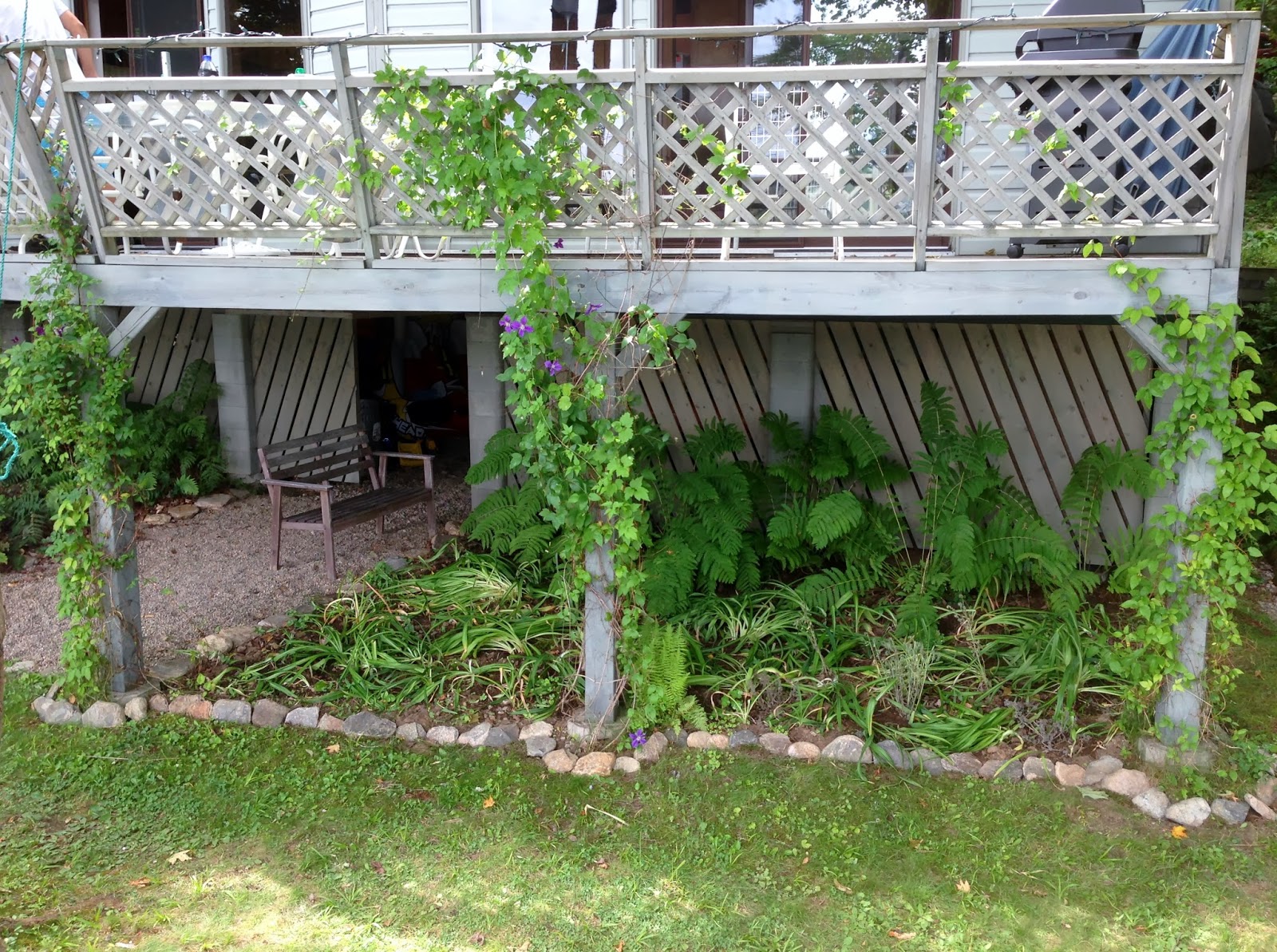
The North Deck Garden is at our Ontario cottage outside of Toronto (zone 4). Like it sounds, the garden is beneath the deck, so it features shade tolerant ferns as well as daylilies, all harvested from roadside ditches in the area.
As per previous post, the daylilies had to come out because they were not going to fulfill their purpose of hiding where the fence meets the ground; they grow too much towards the lake and its sunlight. On top of that, the further under the deck they are, the less likely they are to bloom.

So I decided to move them to the front and change the garden from a 'fern patch', with ferns randomly filling the space, to a more traditional design with the big ferns at the back and the shorter daylilies in the front.
The daylilies are laying down in this photo after transplant but will come up fresh and vigorous next year, hopefully with enough sun to get at least some blooms. 
(Just fyi - at the base of every pillar are two Clematis: one white and one purple.)

The three of five ferns I had to transplant were all massive and extremely heavy, my guess is fifty pounds.


To keep earth from covering the lawn I always place transplants on a nearby tarp. Having them all collected also helps me to get a sense of how much material I have to work with.

Along with the ferns I added Viper's Bugloss, but I do not expect it to come back, it has such a large tap root it is not a good candidate for transplanting.

I will post some progress photos in early July, by which time I expect it to have filled out quite nicely and a previously muddy patch will have been transformed into lush greenery.

***

Monday, February 24, 2014

UNDERESTIMATING THE SUN

While the influence of the sun in gardening may be obvious to most, I had clearly underestimated it in a number of places last summer, especially how it effects the direction in which a plant will grow. 
Here are 3 examples.

1) 
I prefer to hide the functional aspects of a garden and I planted these daylilies to do just that by covering where the fence and the ground meet. In my mind they were going to mound, as daylilies tend to do, but instead they were clearly reaching for the sun, growing out towards the lake.
If I wanted them to cover up the base of the fence I would have had to plant them slightly behind it to anticipate their forward motion. 

2) 
At the base of this chain link fence I planted peas and Morning Glories. I knew I would need to help guide and wind them through the fence but I had not really appreciated how much I would be fighting the vines' natural tendency to grow away from the fence and towards the light.  
Next time I will plant them on the north side of the fence and use their pull to the south to my advantage.


3)
Once I took note of the lessons above I started looking for other examples around the yard and noticed this shrub whose branches only grow in one direction - towards the lake and the light.

In the retelling it seems obvious, but thinking ahead to how your plants will grow takes practice. Wish me luck, I hope I now have this one licked but sometimes I need to learn things in the garden more than once!

***
Sharing with Garden Tuesday

Saturday, November 16, 2013

THE STRIP II

If necessity is really the mother of invention then she had a hand in this.  
I had extra daylilies - lots of them - and nowhere to plant them.

But a gardener can always find somewhere...

It occurred to me that there was nothing distinguishing about where our driveway enters the street.
High shrubs on either side but plain old flat lawn in the middle.  Adding the daylilies is really all about the foliage; while not quite an urn on a pedestal the height & weight of the daylilies' foliage will give it a somewhat grander feeling whether or not it gets enough sun to bloom under those elms.  It will also help to define the borders which is inherently more formal than two properties that simply blend into one another.
Since it is 100% on my northern neighbour's property I made a proposal which she thought about for a couple of days then happily agreed to. So far we have removed less than a quarter of the grass that will eventually go. 
This is a case where bigger will be better and adding some depth to the dayliliy row will increase that sense of formality as the border lengthens. The red line denotes a natural break where the pavement changes colour. Stopping there feels right, like the two lines may subtly reinforce one another.

Even when they have shrunk down in late summer I can see the potential next year of this no-maintenance garden bed.

Since daylilies bloom later in the season I felt obliged to add something to the mix that will give back earlier in the season.  This week I added 25 daffodils randomly mixed between these two gorgeous varieties:

Centannees Split Cup DaffodilTiritomba Split Cup Daffodil

Centannees Split Cup and Tiritomba Split Cup.


The soil was pretty serious clay. 
I have no fear for the daylilies, who seem able to thrive anywhere, but I am concerned for the bulbs. 
Only time will tell so look for a follow up post next April.


Check out the story of the first time I took over the strip of grass between my neighbour and I.

***
Sharing with Foliage Follow Up.       

Thursday, September 12, 2013

A NIGHT IN THE LIFE - busy bee

I dug out these yellow daylilies on Monday but then it got too dark and for once I did not feel like putting on my headlamp.  I felt tired. Actually tired of gardening. 
It was a strange feeling.
While we have done an absolutely enormous amount of work here this year this feeling still felt unfamiliar and it took me a minute to understand what it was.  

The daylilies sat above ground for days until this evening when we were able to come home earlier than expected, otherwise they were going to have to wait even further, until early next week. 
Dug up. 
Split.
Drying out.
 
Have you ever bitten off more than you can chew in the garden? 
This is not my first time.
Now you understand my motivation for taking advantage of today's unexpected window of opportunity.  Once in the yard I felt refreshed and glad to be outside, so much so that when it got dark I donned my headlamp and happily kept going for another hour.
I prefer to tease apart plants when dividing but this was one giant mass of roots and a flat-edged spade was definitely in order.  These taller yellows will join the shorter reds I divided in the spring.  There is no question that I am going to enjoy having them intermingled rather than in side-by-side clumps AND there are going to be plenty more of them since they had not been divided in a donkey's age.
The clump made 8 very decently sized smaller plants that are sure to thrive next year, daylilies being daylilies.
 
The cup in the photo was for slugs, which I detest, but at least there are fewer than there were in my Toronto shady gardens. 
Mint and Chives had to come out. One of the few times I have put plants straight into the compost; it felt terribly wasteful, another unfamiliar feeling.  I decided I am going to take them all out but will wait until I have the time to guerrilla garden them this fall.
The Hardy Geranium I divided the other week is coming in nicely. I do not think we will get another bloom but the plants are very healthy. Under the glow of my headlamp I transplanted Petunias from the Sun Garden since I had to make room for moving around the Rudbeckia I started from seed (which I hope will look the same as a gift I received for the Lakefront Garden earlier this year).
While this little fella I found stunted and hidden under a Petunia may look like the rest of those Rudbeckia, it may actually turn out to be a red one I direct sowed but had thought none had survived.
To be certain I just need to get a bloom before the frost comes.
Tick tock.

Good night!

***
Sharing with Fertilizer Friday.

Tuesday, August 13, 2013

LAKEFRONT GARDEN - what happened?

Upon our arrival at the Ontario cottage a few weeks back we found a portion of the Lakefront Garden - the portion with the greatest variety of plants including Hardy Geranium, Ox-eye Daisies, Iris, Sundrops and of course the garden-defining Daylilies - had been severely cut back on either side of the steps leading down into the water.

An honest mistake by someone trimming the lawn, but still a disappointment.

This is how it looked this year: B-A-R-E
Compared to how it looked at the same time last year.

Most are tough plants and are already coming back but will not be blooming this year.

This is how the rest of the Lakefront Garden currently looks, a mix of (mostly Kwanso) daylilies, Yellow Loosestrife and Sundrops.

I quickly set about remedying the situation by taking the rest of the Sundrops I started to remove from the Lily Garden last year where they were not getting enough sun. They were past blooming but at least they filled in the empty space somewhat. I also added in some Fuscia; though annuals are not normally my cup of tea they are hard to beat when you require immediate colour.

Friends bought me these "Autumn Colours" Rudbeckia which I just love.  I truly hope they take and become a permanent part of the Lakefront Garden where they were a welcome and timely addition. 

Have you ever found an unexpected and drastic change to your own gardens?
What did you do?

***

Monday, June 24, 2013

SPREADING THE LOVE - again

Last week I wrote about dividing lilies in the side garden and the other day I did it again in the back garden.
I did not make plans for the back gardens. All the hours I spent this winter imagining, researching and planning were dedicated to the front gardens. Funny that, considering we will spend more time in the backyard than front.

Once I had the font more or less planted I could not help but shift my attention to the rest of the yard and walking past those four clumps of lilies and that massive clump of daylilies was beyond me. I can see that they have not been divided in...well perhaps ever, and with a little help they could actually fill the whole side garden.

Both the daylilies and asiatic lilies are from the previous owners and while perhaps I should have waited to see what colour they are so that their move would be to their permanent home, I just could not wait.  They needed to spread their wings.  Now.

Step 1 - get the tarp. Trying to get all of the soil out of the lawn is a lost cause, best to avoid it from the outset.
Step 2 - survey your riches.  Breaking everything apart gives a good idea how much you have to plant, but I have found that the roots can dry out quite quickly once the soil is removed so I try and eyeball the volume while they are still in clumps to get an idea of density and spread.
Step 3 - knock of some dirt and jostle the root systems between your hands. With slow and gentle teasing it is possible to break them apart and leave them in good health.
Step 4 - plant and water

Now look at how the whole garden is filled to the brim with these lilies. Picture it again in three years - overflowing with blooms I predict.

 While I love daylilies, they are common and I have loads of them so the other lilies are the priority here; most of the daylilies were moved around the corner.

I just hope these lilies are not pink.

***
Sharing with Tips 'n Tricks Tuesday
Blooming Tuesday & Garden Tuesday

Saturday, April 13, 2013

CAMOUFLAGE - what was i thinking?


While I am intrinsically drawn to more earthy, natural elements I have realized that there is a practical reason for choosing something like a colourful daylily for my iPhone case.
Like this shot.

Or this beauty.

In these days of mass customization it made sense to me to get something made from one of my own photos.  

I chose this close up of moss I took at the family cottage while making my new moss and spruce garden.  The juxtaposition of something so natural, age-old and static covering something so modern and on-the-go appealed to me.
I thought I was so clever until an observant, well-meaning critic asked me how I would find it after putting it down out in the garden.  Come to think of it I am not sure I will. 

Yikes. 
I just might end up with 2 'seasonal' iPhone cases!

***
Sharing with Weekend Flowers, Blooming Friday, Floral Friday Fotos & Garden Blogger's Bloom Day


Friday, October 05, 2012

TUXEDO OVERVIEW - front yard

Front Yard

75' Wide Lot
Planning the landscaping for Tuxedo is very different from creating the Ontario Cottage Garden.  That garden almost seemed to create itself once I decided to use the whole property and take my cue from the woodland environment. The Tuxedo yard has more opportunity to hold distinct gardens vs. being one large garden itself.  
It is a bit daunting to be honest.   

One day when I was wondering where to start, I picked up a copy of Canadian Gardening from 2006 and came across an article called "Demystifying Design" offering advice from Thomas Sparling on how to approach planning.
Perfect timing and good advice.

As per his advice I have taken photos and measurements so I can map the whole thing out on graph paper to ensure proportions while I plan different options over the winter.

Below is a photo overview of the front yard.
12.5' between gardens
 I am not sure about why the Globe Cedars are here, but I wonder if the they get progressively  more sun from left to right.  Assuming they were planted at the same time, it is not a bad hypothesis.  Otherwise I can not understand why one would want to draw the eyes from smallest to largest in this configuration.

South Front Garden

The potentially invasive Bishop's weed is well contained.  I do not know what the shrubs are. Check out the pictures below to see if you recognize them.
Pruning out the dead material will be a priority for the fall, nothing particular, just what will have accumulated over the years.  It will breathe more easily come spring.  [editor's note Dec. 30th, it will have to wait until spring]
Any ideas what this plant is?
If it blooms, great, if not, it's days may be numbered - or I may add Clematis to it.
[thanks the Master Gardeners of Manitoba for letting me know this is a Weigela which should have long lasting deep rose coloured blooms in spring]

Once again the Goutweed is remarkably well contained, the edging must go down fairly deep.  I have actually noticed well contained Goutweed at more than a few neighbours on the block.

Any ideas what this plant is?
[Thanks to the Master Gardeners of Manitoba for letting me know that this may be Amur Maple]


North Front Garden

Daylilies, some sort of mini-Solomon's Seal and Goutweed under the Blue Spruce.

Daylilies have likely not been divided in years and years.
Only a couple of bloom stalks lead me to believe these either have a) not been divided so long they are terribly overcrowded, b) they do not get enough sun here, or c) a combination of both.

How high I trim up the tree is a big decision.  Just the dead ones, or more?

The lawn extends beyond the gardens out to the street.  I may push the globe cedars out there.


Goutweed and a couple of small cedars are not particularly exciting, but the peony seems to have bloomed and that gives me hope for how much sun it gets here, after all, despite the mature elms around it is south facing after all.


I am seriously thinking about undertaking the very big project of using these cedars to create a hedge between our driveway and our backyard.


There are so many white flowers that I might be able to have this entire long garden white.  
Or as they say, a night garden.
Spring, summer and fall.


Hostas all in a row in front of the hedge would be nice, but this is one of the sunnier places and I have no shortage of shadier spots for them.  This will better serve as an opportunity to explore more sun-loving plants after my shady Toronto gardens. [editor's note, Dec. 30th, the hostas have been moved into the north garden]
Any idea on what this hedge is?


Very tall Asiatic Lilies are growing south of the entrance as well as some Lamuim.  Interesting mix since the former prefers full sun and the latter part shade or more.
I'm not crazy about the red mulch but eventually it will break down.


There is no question for me that the first thing I am going to do is to create a "Lasagna" garden (one that does not require removing the grass first) in order to get rid of that grass between the sidewalk and the current garden.
Those big shrubs casting shadow shade will need some serious pruning. 
Are they even needed at all?
Any idea what these shrubs are?


I have decided that this is where I will learn about Alpine gardening.  I already bought of Sempervivum and assorted succulents at the local plant society fall sale. And I will be able to gather stones of decent size from the side of the road on the way home from the cottage.


These daylilies have likely not been divided for years.  I will have lots of material for Guerilla Gardening.

***